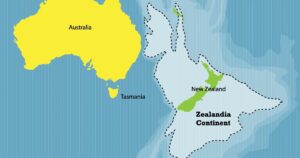
Scientists recently discovered something extraordinary—not a new planet orbiting the Sun, but a massive hidden continent right here on Earth. Geoscientists officially recognized Zealandia, a largely submerged landmass that once formed part of the ancient supercontinent Gondwana.
Dutch explorer Abel Tasman first identified Zealandia in the 1700s, but researchers dismissed it for centuries as merely a scattered group of islands. Zealandia spans 1.89 million square miles, yet about 94% of it lies underwater, making it invisible to most people. Modern mapping and geological studies have now confirmed its continental crust and distinct geological features, granting it recognition as the world’s eighth continent. According to Times Now, this breakthrough reshapes how we understand Earth’s geography and history.
The discovery shows how much of our planet still remains unexplored. While humanity maps the stars and searches for new worlds, Zealandia proves that Earth still hides major secrets beneath its oceans.
Discoveries in Zealandia
When scientists began mapping Zealandia in detail, they not only confirmed it as a continent—they uncovered remarkable geological evidence:
1. Complete Mapping of Zealandia (2023)
Researchers fully mapped Zealandia underwater for the first time in history. This achievement revealed the continent’s ancient geological backbone stretching across the submerged landmass.
2. Volcanic Regions
Scientists discovered a giant volcanic region roughly the size of New Zealand, showing Zealandia’s dynamic and active geological past.
3. Seabed Rock Samples
Expeditions near New Caledonia collected seabed rocks from North Zealandia. These samples confirmed the presence of continental crust, proving that Zealandia is more than a chain of islands.
4. Magnetic Anomalies and Geological Units
By dating rocks and measuring magnetic anomalies, researchers mapped Zealandia’s major geological units. Their findings revealed how it slowly separated from Gondwana over 100 million years ago.
5. Isolation and Size
Zealandia covers 1.89 million square miles (4.9 million km²)—making it larger than India. Its isolation from Australia and its thicker continental crust distinguish it clearly from ordinary oceanic crust.
Why This Discovery Matters
Recognizing Zealandia as a continent transforms our understanding of Earth. It proves that even today, entire continents can remain hidden beneath the oceans, waiting for science to uncover them.
Zealandia’s volcanic systems, ancient rocks, and continental crust offer vital clues about:
-
Plate tectonics
-
The breakup of Gondwana
-
How Earth’s continents formed and drifted
-
The geological forces shaping the Pacific region
While people may wonder about discovering an “eighth planet,” Zealandia reminds us that Earth holds its own eighth continent—a vast world hiding in plain sight below the waves.