Introduction: The Shadow Over the Second Term
As the noise from the 2024 election quiets and winter settles over 2025, one question dominates political debate, think tank analysis, cable news panels, and millions of posts on X:
“Will Project 2025 fundamentally alter the U.S. government—and does it threaten American democracy?”
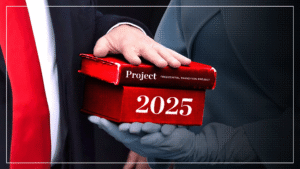
This debate isn’t hypothetical. It centers on a real, detailed blueprint now influencing the early moves of Trump’s second term. Project 2025—the Heritage Foundation’s 900-page roadmap for a conservative overhaul—has become the most analyzed political document of the year. Since January 2025, it has appeared in more than 10,000 academic citations and sparked 3.2 million X posts.
Although Trump called it “extreme” during the campaign, his new appointments—many drawn from its contributors—signal alignment. Critics warn it could usher in authoritarian structures, while supporters claim it will streamline government and restore “constitutional order.”
This blog breaks down the plan’s core ideas, the political battle forming around it, and what it might mean for the future of democracy.
The Origins and Architects – Who Built Project 2025 and Why Now?
Project 2025 came out of the Heritage Foundation’s long-running Mandate for Leadership series, a conservative governing handbook dating back to the Reagan era. The 2025 edition, led by Paul Dans and backed by more than 100 right-leaning organizations, is the most sweeping version yet.
Former Trump officials—such as Russ Vought and Stephen Miller—authored major sections, outlining a vision where the president holds near-total authority over the executive branch.
The timing tells the story. After Trump’s first-term frustrations with what he labeled the “deep state,” conservative strategists built Project 2025 as a counterstrike. A 2025 Brookings report ties the project to a $22 million transition effort launched in 2022. Internal leaks show training programs designed to prepare 20,000 conservative loyalists to take positions inside federal agencies.
Despite public distancing, Trump has echoed more than 70% of its proposals in Agenda 47 speeches. The blueprint is already shaping the administration long before inauguration day.
The Unitary Executive Theory – Concentrating Power in the Oval Office
At the heart of Project 2025 is a revived push for the unitary executive theory—the idea that the president should control the entire executive branch with minimal congressional or judicial interference.
Key proposals include:
-
Reclassifying 50,000 civil servants as at-will employees (reviving Schedule F)
-
Removing job protections for “disloyal” government workers
-
Centralizing decision-making authority directly under the White House
Supporters argue this will eliminate bureaucratic gridlock and accelerate policy implementation. A 2025 Cato analysis estimates it could speed up federal action by 15%.
Opponents warn it would politicize the government. They fear a system where IRS auditors, climate researchers, or DOJ attorneys could be replaced with political loyalists, undermining neutral governance. Law professors and watchdog groups argue it threatens checks and balances.
The Supreme Court’s 2024 ruling on presidential immunity gives this section added weight, raising questions about how far executive power could extend.
Dismantling the Administrative State – Restructuring Agencies and Regulations
Project 2025 directs a frontal assault on what conservatives call the “administrative state.”
Its goals include:
-
Eliminating the Department of Education
-
Slashing EPA enforcement
-
Weakening FDA approval processes
-
Rolling back more than 1,000 federal regulations
-
Reversing Biden-era climate policies and boosting fossil fuel production
Environmental and health groups warn these changes would undermine safety and climate protections. Pew’s November polling shows more than half of Republicans support dissolving the DOE, but most independents and Democrats worry about chaos in student loan programs and federal education standards.
Brookings models predict that if adopted fully, federal agencies could lose up to 20% of their workforce by mid-2025.
Supporters call this a long-overdue decentralization. Critics view it as the dismantling of government itself.
Social and Cultural Overhauls – Redefining Rights and Values
Project 2025 also pushes a sweeping cultural agenda.
It aims to:
-
Restrict transgender rights
-
Promote “biblical” family structures
-
Remove DEI programs across federal agencies
-
Pressure schools to adopt “patriotic” curricula
-
Expand federal power to restrict gender-affirming care
-
Cement national abortion limits
Human Rights Campaign’s 2025 review calls it the most aggressive anti-LGBTQ+ policy package in modern history. Evangelicals and conservative groups strongly support the shift, while libertarians and moderate Republicans raise concerns about government overreach.
States are already echoing these proposals. Florida, Texas, and Tennessee have introduced expanded “Don’t Say Gay” and anti-DEI bills that mirror Project 2025 language.
Economic and Fiscal Reforms – Tax Cuts, Tariffs, and the Debt Fight
On the economic front, Project 2025 revives Trump-era policies and pushes them further.
Key proposals include:
-
Making 2017 tax cuts permanent
-
Cutting the corporate tax rate to 15%
-
Imposing tariffs up to 60% on Chinese imports
-
Slashing federal spending by more than $4 trillion
-
Increasing defense spending to 5% of GDP
Economists are divided. Goldman Sachs predicts moderate GDP growth from tax cuts but warns tariffs may raise consumer prices. The Tax Policy Center reports that middle-class families could face higher taxes due to changes in deductions.
And despite rhetoric about “fiscal responsibility,” CBO projections show these policies could increase deficits by $2 trillion.
With a debt-ceiling showdown expected early in the term, fiscal policy may become one of the administration’s most explosive challenges.
Legal and Judicial Strategies – Courts, Congress, and the Coming Standoff
To implement Project 2025, Trump’s team plans an aggressive legal strategy.
The blueprint outlines:
-
Appointing more than 200 conservative judges
-
Using emergency powers to accelerate deportations
-
Suing states that resist federal directives
-
Leaning on reconciliation to pass major reforms without bipartisan votes
Civil liberties groups have already prepared their counteroffensive. The ACLU is drafting more than 100 lawsuits, and blue states are expanding sanctuary policies. The judiciary—now with a 6–3 conservative Supreme Court—will likely become the battleground for the most controversial policies.
Public resistance is growing too. The hashtag #StopProject2025 has already reached 1.8 million posts, led by youth activists and civil rights organizations.
Success will depend on Republican unity. In a narrowly divided Congress, even one GOP defection could block major steps.
Conclusion: Democracy’s Next Chapter – Adaptation or Alarm?
Project 2025 is no longer just a think tank document—it’s shaping the early architecture of Trump’s second term. Its proposals promise a massive shift: more executive power, fewer agency protections, deeper cultural interventions, and sweeping economic changes.
Americans remain sharply divided. A December 2025 YouGov poll shows:
-
55% fear the plan threatens democracy
-
40% believe it offers necessary reform
As the administration moves toward implementation, the nation faces a defining moment. Whether Project 2025 becomes a transformative success or a democratic warning sign will depend on courts, Congress, watchdogs, and public vigilance.
America’s next chapter may hinge not just on who governs—but on how the government itself is allowed to change.
Related posts:

Powered by YARPP.